FastPix for live events
Video API for live events
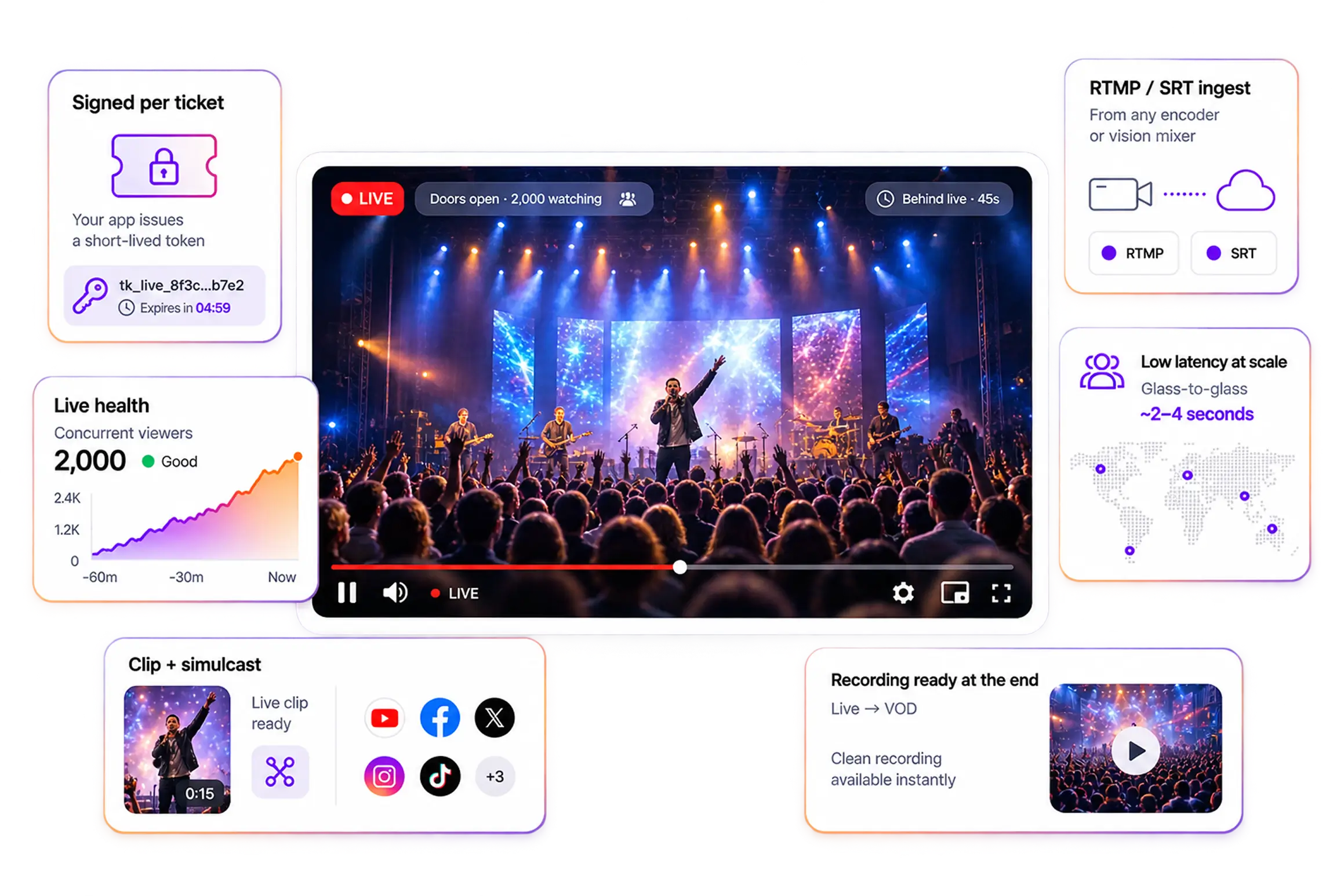
FastPix Video API has everything you need to broadcast a live event. Ingest from any encoder, low-latency delivery at scale, ticketed access, and a recording that is ready the moment it ends.
Billed per minute, never on concurrent viewers, so a big crowd is good news. $25 in signup credits, no credit card.
Trusted by teams shipping video at scale





Why FastPix
Complete video infrastructure for live events
One API, whole stack
Ingest, transcoding, delivery, DVR, clipping and data all come from the same API key.
Built for scale
Multi-CDN delivery scales with the audience, so a spike runs on the same setup as a quiet hour.
Secure by default
Every stream sits behind a signed link your app issues, so a forwarded URL stops working.
Pay per minute
Billed on minutes rather than concurrent viewers, so a large audience costs what it used.
Developer reference
Every endpoint a live event platform uses
Everything on this page maps to a documented call, grouped the way an event runs from load-in to archive.
Live ingest
Playback and DVR
Ticketed access
Health and scale
Clipping and simulcast
Customer story
The stream ran for eight hours without a single crash or buffer spike. We saw some viewers switch networks, others drop to low resolution, but the stream never broke.
Aditya Rana
Platform Engineer, Oceaniek Stream
Live ingest
RTMP and SRT ingest from any encoder or gallery
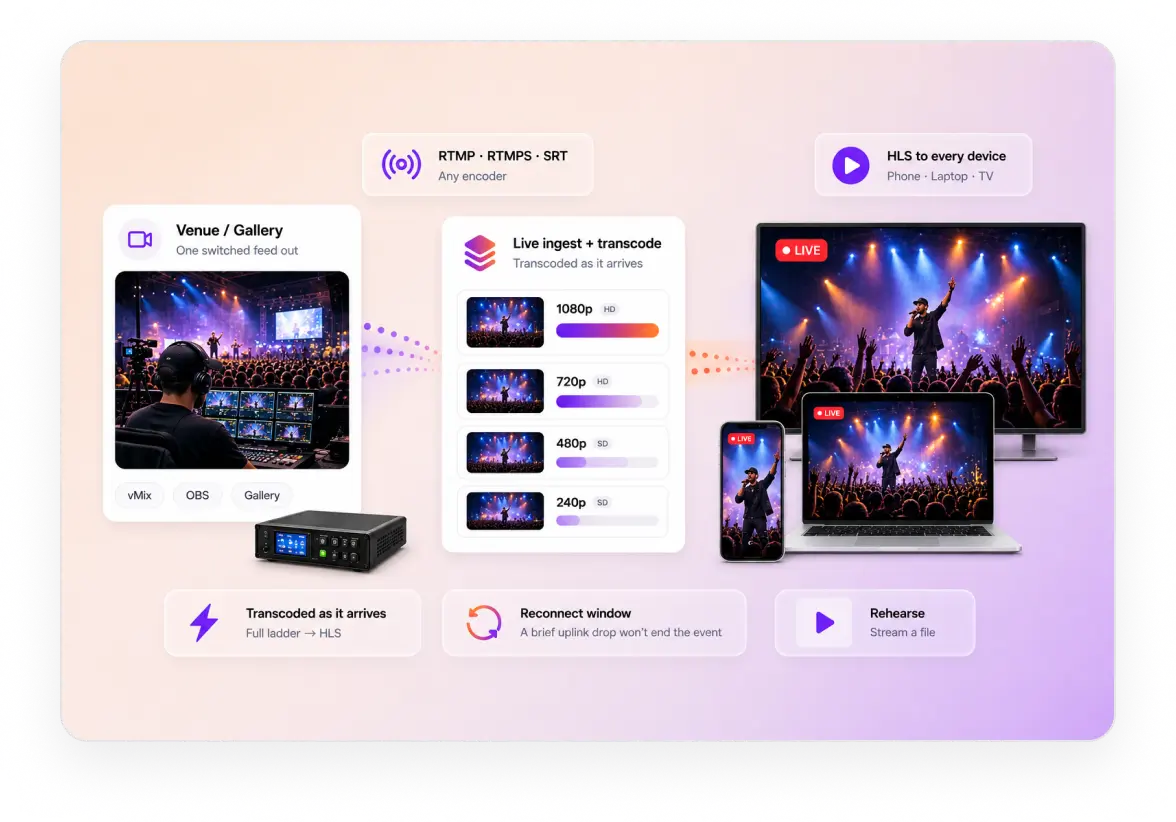
Take the feed from wherever it starts, vMix, OBS or a hardware encoder at the venue. FastPix transcodes it and broadcasts it as HLS, so the show plays on every device.
RTMP, RTMPS and SRT ingest from vMix, OBS, a hardware encoder or a phone at the venue. Guide
Real-time transcoding into a full ladder, so a viewer on hotel wifi gets a rendition that plays. Guide
A reconnect window on a dropped uplink, so a brief outage does not end the event. Guide
Run the rehearsal as a live stream by streaming a pre-recorded file, and test the exact path before doors. Guide
Delivery and DVR
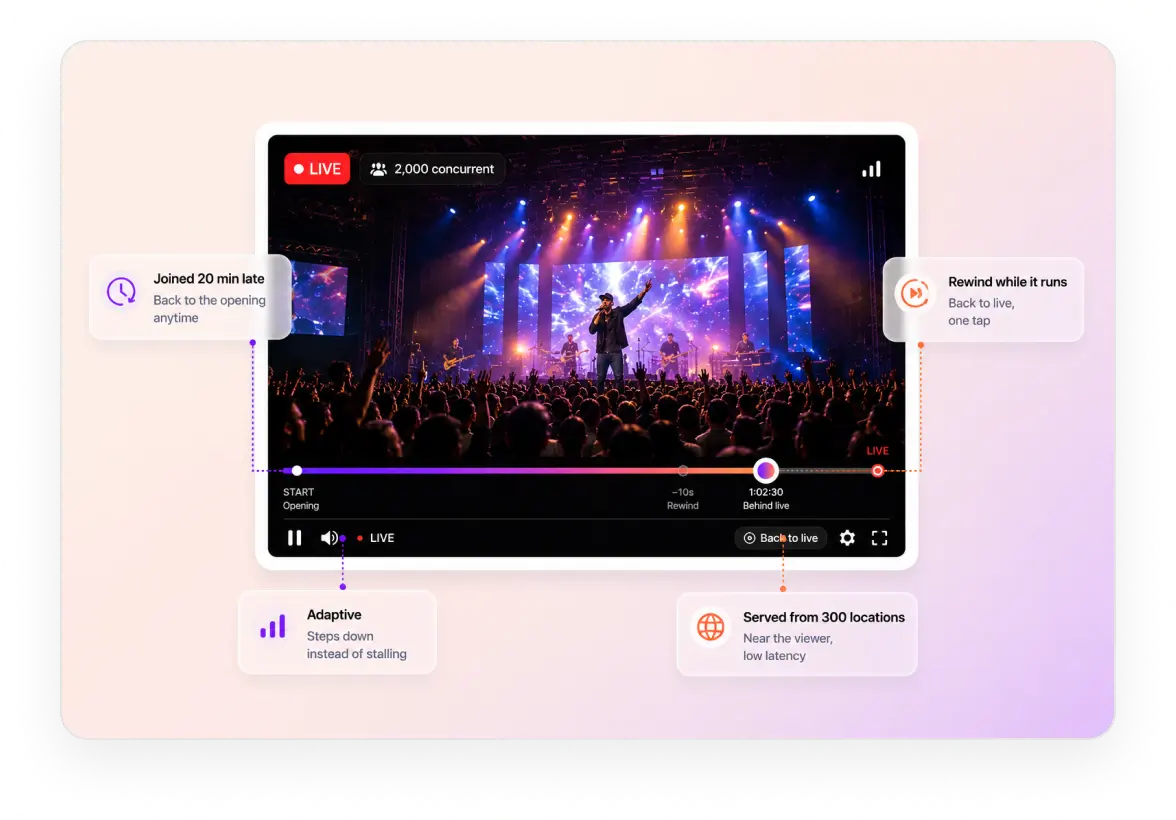
Low latency delivery with DVR for a live audience
FastPix packages the stream as LL-HLS and serves it from 300 locations, so the audience stays close to the moment. DVR lets anyone who joined late start at the beginning.
Adaptive bitrate on every stream, so a viewer on a train steps down a rung instead of stalling. Guide
DVR and rewind while the show runs, then return to the live edge whenever they want. Guide
Billed on minutes, never on concurrent viewers, so an audience that doubles does not change the plan.
Player SDKs for web, iOS, Android, Flutter and React Native, all driven by one playback ID. Guide
Ticketed access
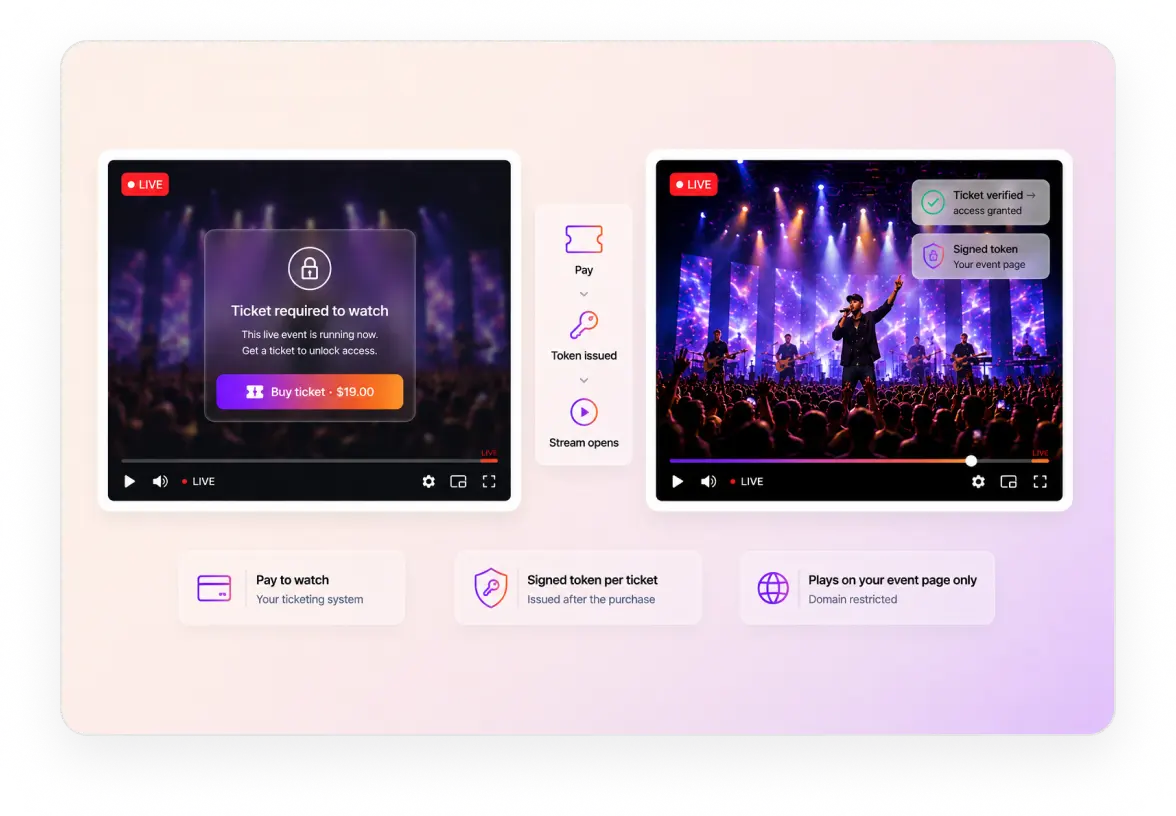
Signed playback URLs and DRM for a ticketed event
FastPix opens the stream only for a token your app issues after checking the ticket. A forwarded link expires quickly, and studio DRM sits on top for premium rights.
A signed token per ticket holder, short-lived and issued by your service after it checks the order. Guide
Studio DRM where a rights holder requires it, Widevine, FairPlay and PlayReady on top of the signed link. Guide
Delete the playback ID and the event closes for everyone at once, whatever tokens are outstanding. Guide
Domain restriction and browser rules, so the stream plays on your event page and nowhere else. Guide
Monitoring
Live stream health and real-time viewer monitoring
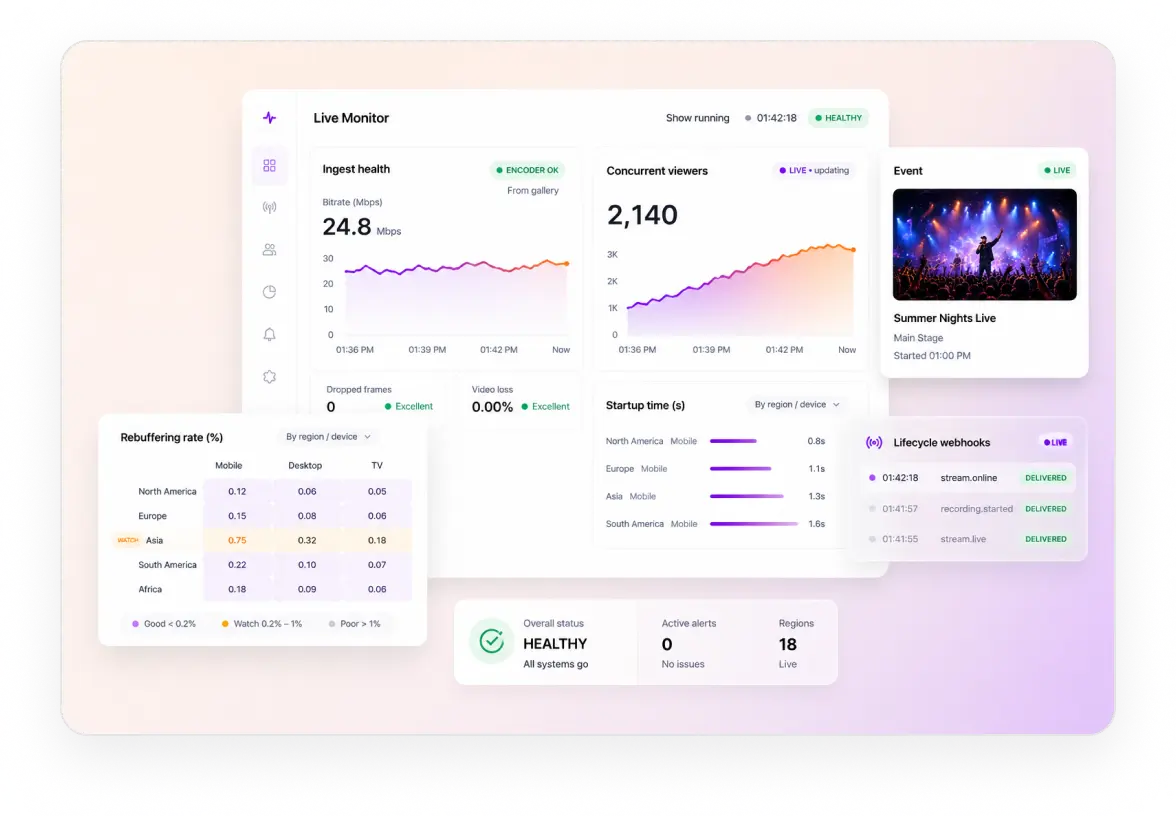
FastPix reports the state of the feed and the audience while the show is still running. Operations sees an ingest problem before the audience does, and the viewer count moves in real time.
Ingest state, bitrate and dropped frames reported live, so a failing encoder is visible from the gallery. Guide
Concurrent viewers from an endpoint, so the number on the wall is the real one. Guide
Startup time and rebuffering by region and device, which separates a bad show from a bad connection. Guide
Webhooks on every lifecycle event, so your run of show reacts without anyone watching a dashboard. Guide
Clipping and simulcast
Live clipping and simulcast to every platform
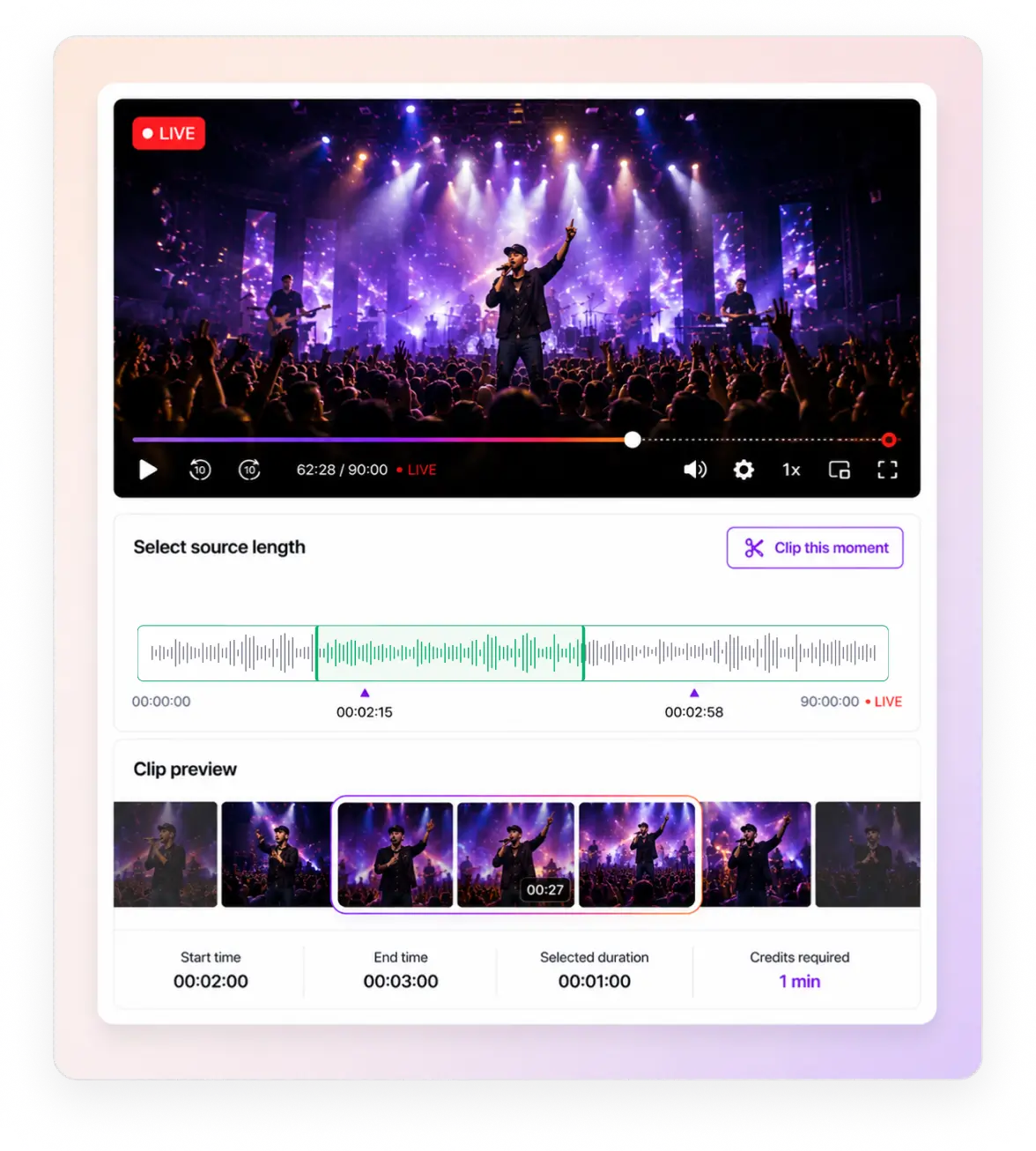
FastPix cuts a moment out of a running stream and pushes the same feed to YouTube or Facebook at the same time. A highlight reaches social while the show is still on.
Clip mid-show by marking a start and end, and get a shareable asset back without waiting for the end. Guide
Simulcast to YouTube, Facebook and any RTMP endpoint, in sync, with no second encoder to run. Guide
Create, update and delete a simulcast target through the API while the show is live. Guide
Every clip is its own asset with its own playback ID and its own completion data. Guide
After the event
Live to VOD, highlights and an always-on channel
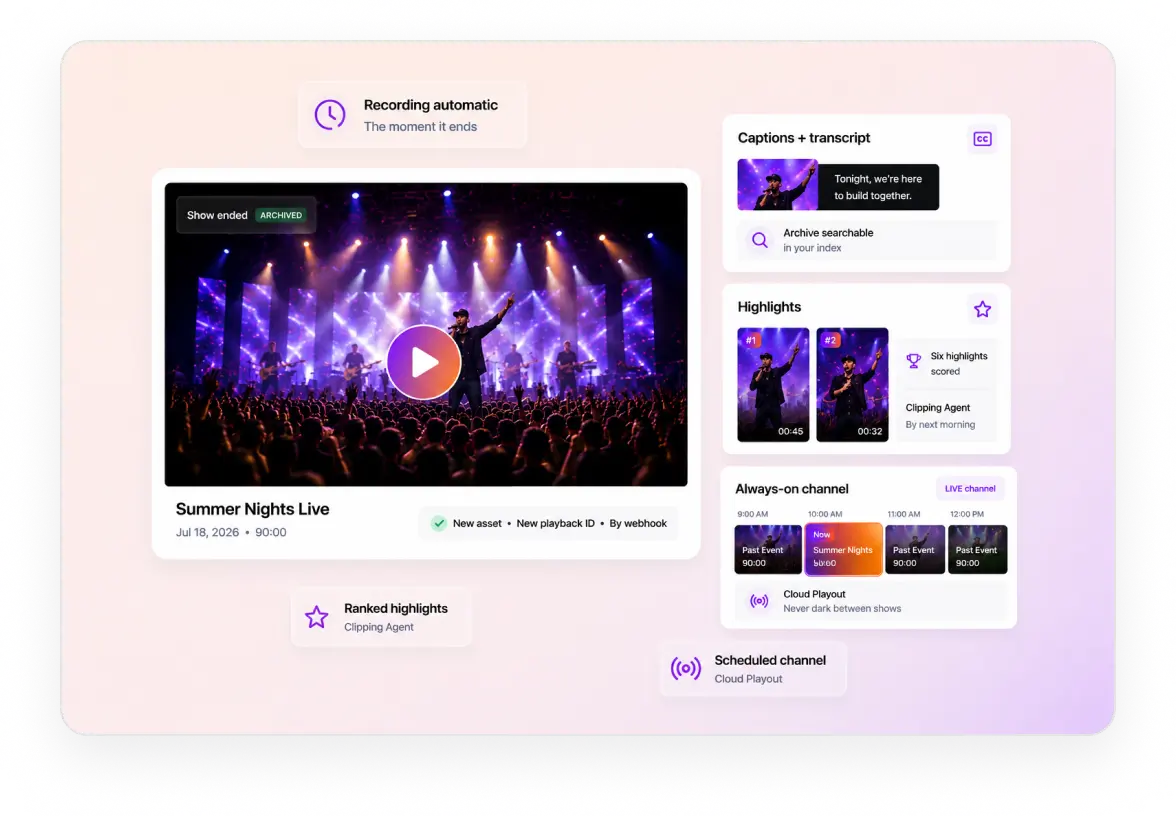
FastPix records every stream automatically, so the show becomes an on-demand asset the moment it ends. From there it gets captioned, clipped into highlights, and scheduled onto a channel between events.
Recording is automatic on every stream, landing as an on-demand asset with its own media and playback ID. Guide
Captions and a transcript on the recording, so the archive is searchable in your own index. Guide
The Clipping Agent scores the recording and returns ranked highlights for the next morning. Explore
Cloud Playout schedules past events as a channel, so the app is never dark between shows. Guide
Benchmarked against five video APIs
Startup and delivery, measured against five video APIs
An event audience arrives all at once, so the first frame and the steadiness of delivery are the two numbers that decide whether it feels professional. Same file, same region, same network.
Doors open and everyone presses play in the same minute. Gumlet posted 1.12s on a few runs only, so it is not treated as comparable.
Uneven delivery is what stalls a stream halfway through. At 103% the speed was swinging wider than its own average from one moment to the next.
These are VOD measurements from the open harness, not a live test. A live benchmark does not exist yet, so treat these as the delivery layer rather than as an event result. Oceaniek ran eight hours at 2,000 concurrents with no crash.
How it comes together
What it takes to broadcast a ticketed live event
Five steps between load-in at the venue and a recording your audience can rewatch.
Create the stream
One call returns a stream key and an ingest URL for the encoder at the venue.
GuideRehearse on the real path
Stream a pre-recorded file as live and watch it arrive exactly as the show will.
GuideGate it to ticket holders
Your ticketing system confirms the order, then your service issues a short-lived token.
GuideWatch it while it runs
Ingest health, concurrent viewers and playback quality all report during the show.
GuideTurn it into the archive
The recording lands automatically, gets captioned, and clips into highlights.
GuideKeep reading
Go deeper on video for live events
Build guides, clipping and delivery, for teams broadcasting live to a paying audience.
How Oceaniek launched in 48 hours
Ingest to playback with one developer, 2,000 concurrents, no crash.
StoryInstant live clipping
Cutting a shareable moment out of a stream while it runs.
GuideSimulcast to multiple platforms
Pushing one feed to YouTube, Facebook and any RTMP endpoint.
GuideStream pre-recorded content as live
Running a rehearsal, or a pre-taped segment, down the live path.
GuideAI video clipping
Scoring a finished recording into ranked highlights.
AgentCloud Playout
Scheduling past events as a channel between shows.
ProductBring your next event
Tell us how the show runs, from the gallery output to how tickets get checked. We will walk the ingest path with you, and talk through what happens when the venue uplink drops.
Prefer to build it yourself? Start building
Common questions
Live event streaming questions, answered.
Which ingest protocols do you support?
RTMP, RTMPS and SRT. SRT is the one to use over an unreliable venue uplink because it recovers lost packets. RIST and WHIP are not supported, and there is no WebRTC, so a two-way interactive format sits outside this stack. Set up guides exist for OBS and vMix.
Can we restrict an event to certain countries?
No. There is no geographic or IP restriction. The available controls are signed tokens, domain restrictions, browser rules and DRM. If a rights deal requires territorial enforcement, your entitlement service has to check the region before it issues a token, and that check is yours rather than ours.
What happens if the uplink drops mid-show?
A reconnect window holds the stream open so a brief outage does not end the event, and the encoder can reconnect on the same stream key. A documented secondary backup ingest URL does not exist today, so if your show needs true dual-path redundancy, raise it with us before booking.
How do we stop one ticket being shared with ten people?
Your service issues a short-lived signed token per buyer, so a forwarded link expires quickly. Concurrent-session limits are enforced in your entitlement service, which decides whether to keep issuing tokens. There is no forensic watermarking, so a leaked stream cannot be traced back to the buyer.
Pricing
Rate card
Per minute, with the player and analytics already in it. Never billed on concurrent viewers. See full pricing.
ENCODING
Pay per minute encoded
$0.0267/min 1080p Pro
Per-title ABR encoding across H.264.
STREAMING
Pay per minute streamed
$0.00067/min 1080p Pro
Multi-CDN delivery from 300+ POPs.
STORAGE
Pay per minute stored
$0.00268/min 1080p Pro
Assets stored and CDN caching, lifecycle handled.
Support
Three ways to get unstuck
Engineering
Engineering support
Stuck on an API call, a webhook signature or a player integration? Reach the engineering team directly, and hear back in hours rather than days.
Contact engineeringDocs
Integration help
Quickstart guides, SDK examples and playback logs in your dashboard, for the integrations most teams hit first.
Browse the docsCommunity
Solution architect
A new build, a migration off another platform or a complex multi-tenant rollout. Plan it with a FastPix solution architect.
Join the Slack community