VIDEO API
Upload, stream measure and understand video from one video API
FastPix handles the parts of video that are hard to build: encoding, delivery, players, quality data and video understanding. One API key, one asset model, one bill.
$25 in credits. No card. Real engineers answer support.
TRUSTED BY PRODUCT TEAMS SHIPPING VIDEO AT SCALE






THE HONEST PICTURE
Adding video is not a feature.
It is a distributed system.
Seven systems, fifty-six moving parts. On the left is what a team signs up for building video in-house. On the right, the same outcome on FastPix. Neither side is exaggerated, and the long version is here.
Without a video API
56 line items your team owns · ~186 engineer-weeks before anyone watches anything
With a video API
51 off your plate · 6 that are actually your product
Every line item. Who actually owns it.
The greyed tiles do not disappear. Someone still runs them - just not your engineers. The six on the right are the ones your users would notice if you stopped.
“When developers don’t have to deal with operational headaches, they can focus more on being creative and innovative.”
Jonathan Melville · Principal Team Leader, Chick-fil-A
WHY TEAMS PICK IT
What you actually get
Ship in an afternoon
Send one video URL, get a playback ID, drop in the player. A production feature takes weeks. An assembled stack takes six to twelve months to reach a first incomplete version.
Fast for your viewers too
83 seconds from upload to playable on a 21-minute 1080p file. Over 300 delivery locations. Per-title encoding cuts files around 35 percent at the same visual quality.
Every use case on one API
Upload-and-play, DRM, live, 24-7 channels, AI clipping, search. Same API, same asset, same events. The use case you have not scoped yet runs on the same primitives.
Built for builders
A quickstart you finish in one sitting, a full API and webhook reference, SDKs in seven languages, UI components rather than an embed you cannot touch, and support answered by people who work on the platform.
On-demand video
Video hosting and on-demand playback
Upload direct, by URL, all resumably from web or mobile. Video hosting comes with per-title encoding, HLS and DASH packaging up to 4K, multi-CDN delivery, signed URLs, access policies and DRM. One upload becomes an asset with a playback ID. FastPix player is yours to control on web, iOS, Android, Flutter and smart TVs. Video on Demand
Your app / CMS
Video created or uploaded
Direct upload
Resumable, from browser and mobile
Pull from URL
One API call
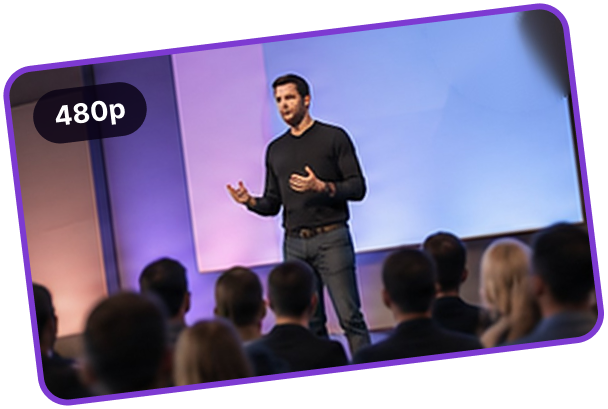
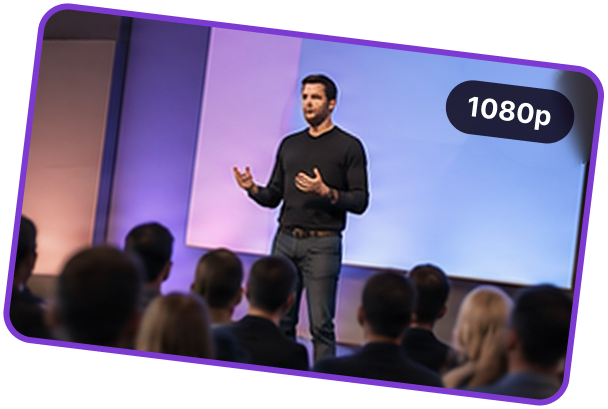

Encode, package & stream
Per-title encoding, HLS and DASH,
multi-CDN delivery, up to 4K.
video.media.ready
webhook
✓Playback ID, into your backend
Signed URLs + DRM
Domain and user agent policies on every asset
Plays everywhere
Measured from the first play
UPLOAD
From your app
INGEST
Direct or from a URL
ENCODE
Per-title, up to 4K
READY
Webhook + playback ID
PLAY
Everywhere, measured
Video ai
Video processing and Video AI
Video processing runs in the same call that encodes the file. Timestamped, speaker-separated transcripts. Chapters, summaries, named entities. Scene analysis, on-screen text and object detection. Moderation flags unsafe content on upload. In-Video AI
Primitives first, products second
- Timestamped, speaker-separated transcripts
- Chapters, summaries and named entities
- Scene analysis, on-screen text and object detection
- Moderation that flags unsafe content on upload
- AI clipping, vertical reframing and search, built on the same outputs
- Structured data you can feed to your own model instead, if you prefer
WHAT YOU BUILD
in-video Q&A
Recommendations
Event-driven workflows
RAG pairing
Training Models
WHAT WE BUILD ON THE SAME FEATURES, WHICH YOU CAN ALSO USE
AI Clipping
AI Reframe
AI Moderation
AI Search
Training Models
AI FEATURES YOU CAN USE
Transcript
Chapters
Summaries
Entities
Scene Analysis
OCR
Objects
One asset, the file you already uploaded
FastPix Video AI & Agents
Agents are built with the underlying API features of Transcript, Chapters, Summaries, Entities, Scene Analysis, OCR, Objects.
Video data
Video analytics: quality of
experience and audience insights
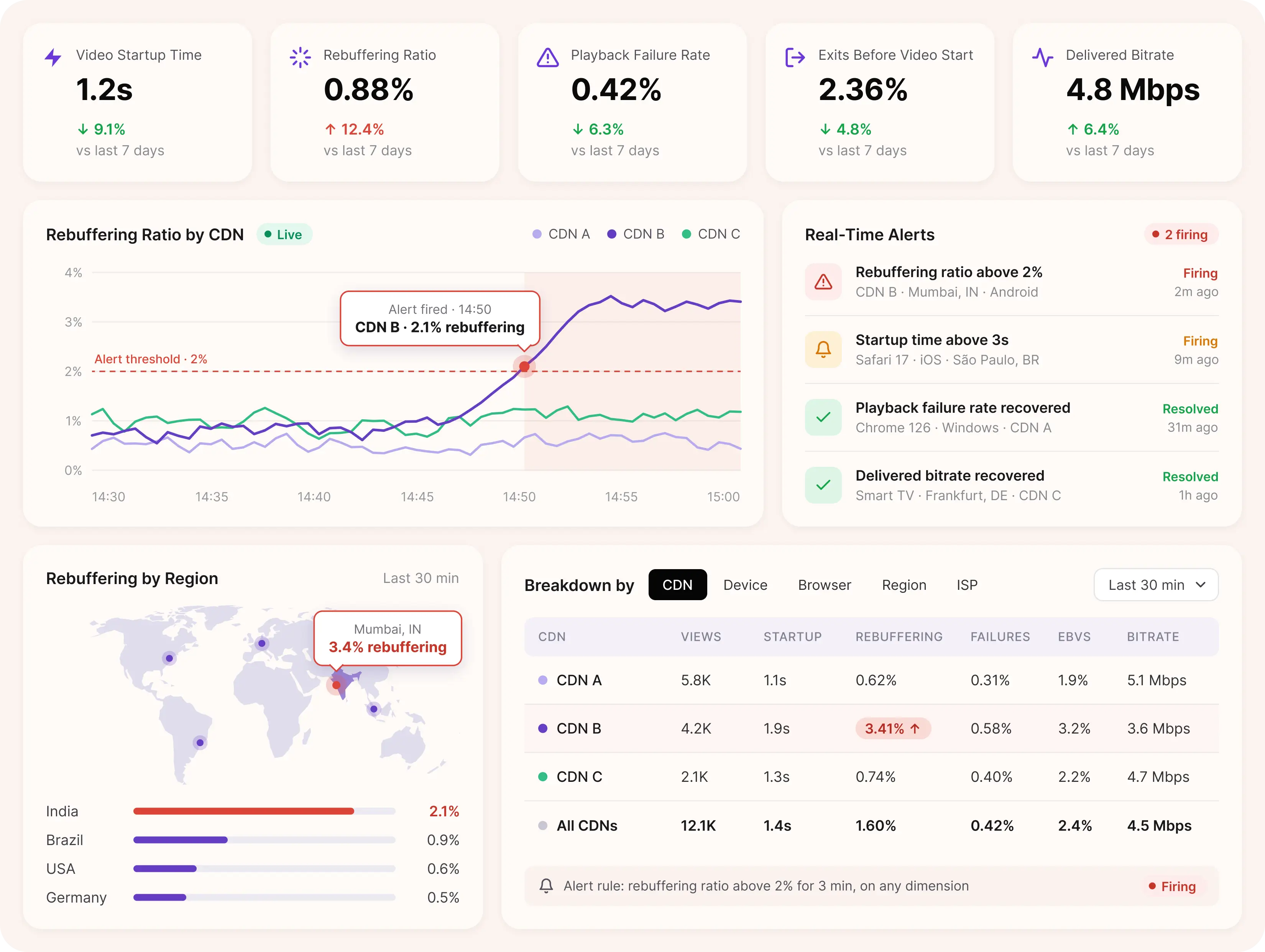
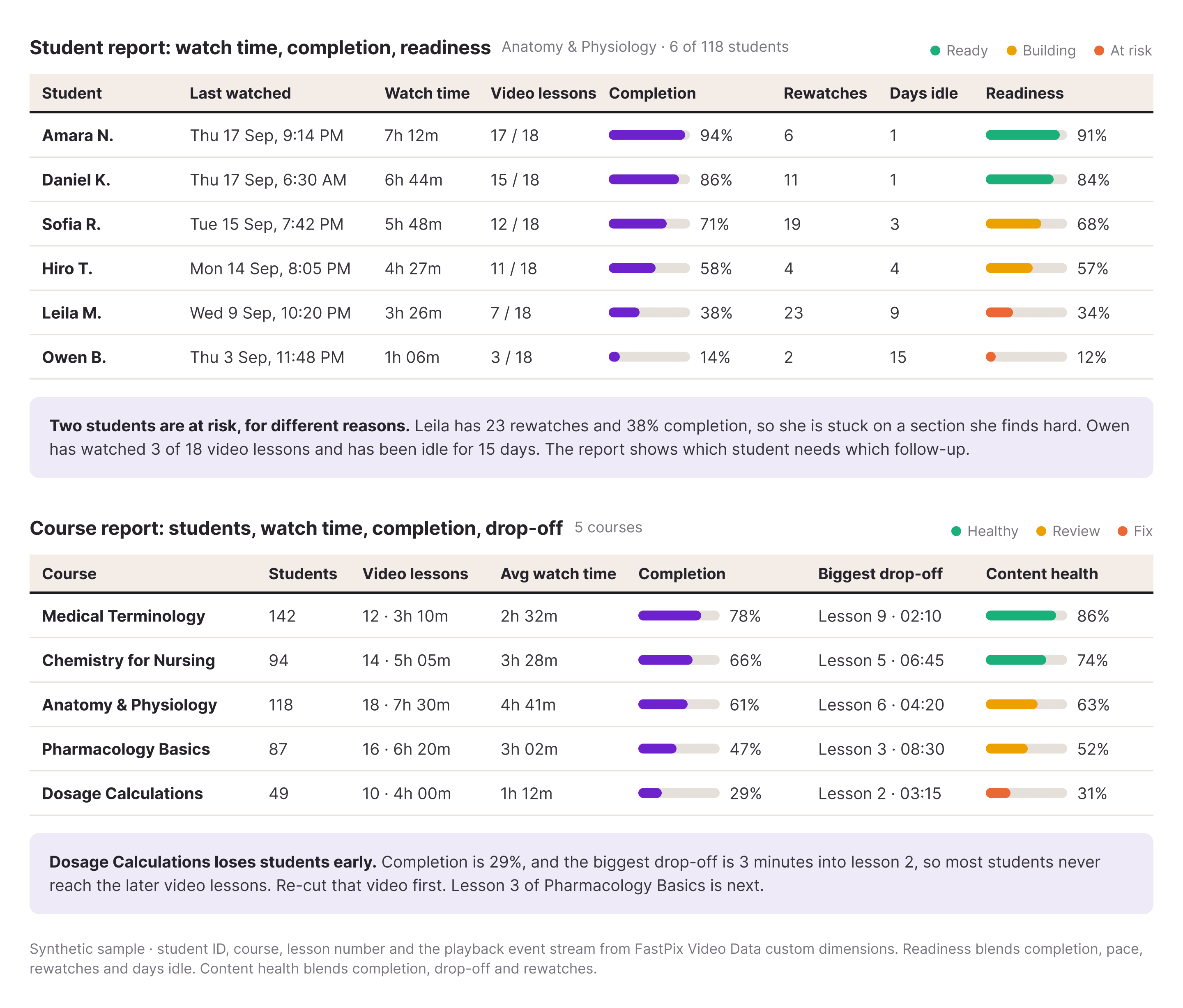
Video analytics pulls quality of experience and engagement metrics from any player, across 56 dimensions, ten of them yours to customise. Watch time, rewatches, skips, startup time, buffering, etc. are all signal data you get in real-time to programatically improve your retention, consumption and growth. Video Data
1{2 "success": true,3 "data": {4 "status": "COMPLETED",5 "result": {6 "scenes": [7 {8 "startTime": 0.0,9 "endTime": 1.478,10 "description": "A computer screen displaying a chat application with a list of steps for modifying the application."11 },12 {13 "startTime": 1.478,14 "endTime": 3.44,15 "description": "A woman in a blue dress is seated, smiling and speaking. The background includes modern wall decor."16 },17 {18 "startTime": 3.44,19 "endTime": 8.12,20 "description": "Close-up of fingers typing lines of Java code on a mechanical keyboard with RGB backlighting."21 }22 ]23 }24 }
Live streaming
Live streaming API
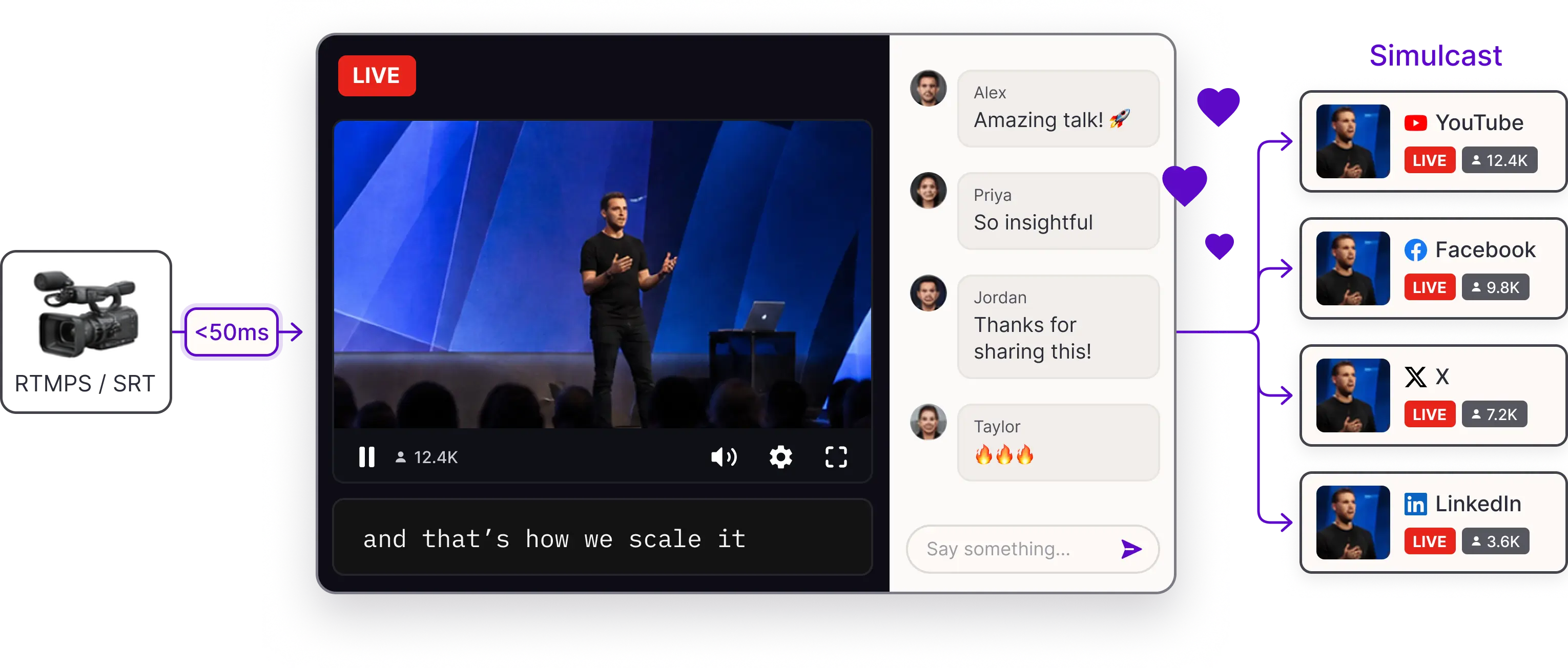
The live streaming API takes RTMPS and SRT ingest. Low-latency delivery. Time shifting, so viewers can pause and catch up. Instant clipping of a stream that's still running. Simulcast to YouTube, Facebook, X and LinkedIn. Live captions. When the stream ends it becomes an on-demand asset by itself. Live Streaming
One stream, every surface
- RTMPS and SRT ingest, low-latency delivery
- Time shifting so viewers can pause, rewind and catch up
- Instant clipping of a stream still in progress
- Simulcast to YouTube, Facebook, X and LinkedIn
- Live captions on RTMP streams
- Under 50ms to roughly 95 percent of the internet
Cloud playout
Cloud playout and 24-7
channels
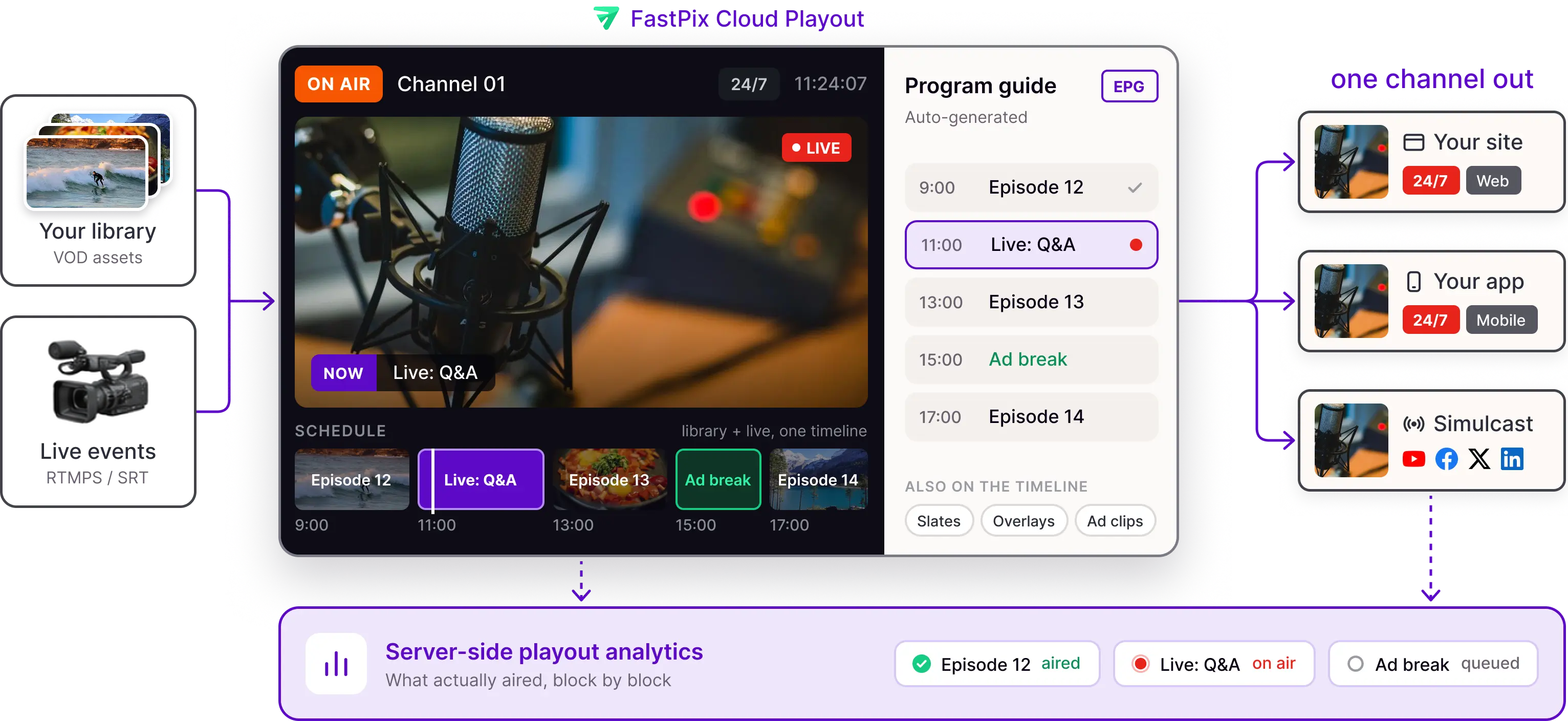
Cloud playout programs your archive into a schedule with an auto-generated EPG. Splice in live events. Add slates, overlays and your own ad clips. Put it out to your site, your app and other platforms at once. Cloud Playout
A broadcast channel without broadcast hardware
- 24-7 linear channels programmed from your existing library
- Scheduling with an auto-generated program guide
- Live events spliced into the same timeline
- Slates, overlays and your own ad clips
- Server-side playout analytics on what actually aired
- Three people is enough to run one
Agents
Video AI agents
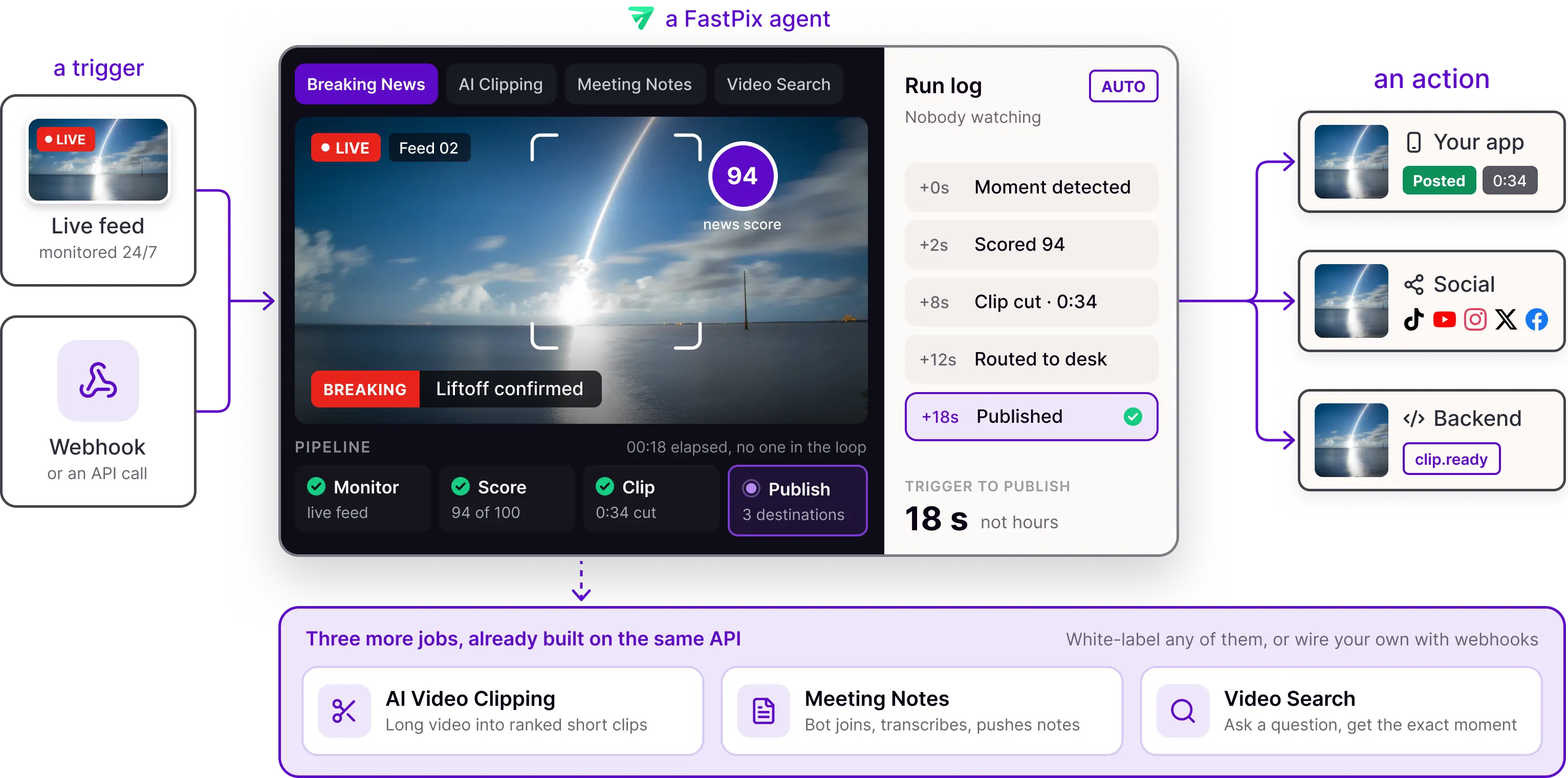
Point a trigger at an agent and the job runs on its own. Breaking news, clipping, meeting notes, video search. White-label any of them inside your product, or wire your own with webhooks and the same primitives. Agents
Four jobs already built, on the same API
- Breaking News: monitor, score, clip and publish
- AI Video Clipping: long video into ranked short clips
- Meeting Notes: bot joins, transcribes, pushes structured notes
- Video Search: ask a question, get the exact moment
- White-label any of them inside your own product
- Or wire your own, using webhooks and the same primitives
And so much more
Seventy video features you would otherwise build
Every item here is something a video product eventually needs. Every item is also something you don't write.
Build or buy
What building video infrastructure yourself costs
Conservative estimates for a competent team, with the work overlapping in calendar time rather than adding up.
6-12 months
To a first, incomplete build. The player and the analytics are the long poles, and analytics is the row most teams start and never finish.
5x faster
To launch on FastPix, and the gap widens afterwards, because your own stack turns that list into maintenance that never ends.
~60%
Of Aadhan's engineers moved off running video and onto building product, by their own account, after switching.
The point isn't the months you save. It's that your team spends the year on what makes your product different, already having video that is. If video itself is your product, build it: a novel codec, sub-second latency at scale or an air-gapped deployment are all good reasons to own the pipeline. Here is where the months actually go, including when we would tell you not to buy. Already running video? Our engineers can run the migration.
In your stack
Video SDKs for the languages you already use
Server SDKs
Upload from the browser or the app
Keep your player, keep the data
Already running video elsewhere
Speed at runtime
2x faster from upload to playable
On a 21-minute 1080p source, FastPix had the asset playback-ready in 83 seconds. The next provider took 142, and one vendor timed out. Buying the abstraction shouldn't cost you speed at runtime.
Time from upload to playable · 467MB / 21-min source
83 seconds
Single end-to-end measurement: HTTPS upload + transcode + first playable manifest. Same source file, same region, same network.
Show vendorsBuilt for your shape of video
Video streaming built for your kind of product
Pricing
Per minute encoded, delivered, and stored
No platform fee, no per-seat charge, no separate invoice for each surface. See full pricing.
Encoding
Pay per minute encoded
$0.0267 /min 1080p
Per-title ABR encoding across H.264
Pro
Streaming
Pay per minute streamed
$0.00067 /min 1080p
Multi-CDN delivery from 300+ POPs.
Pro
Storage
Pay per minute stored
$0.00268 /min 1080p
Assets stored and CDN caching, lifecycle handled.
Pro
FAQ
Video API questions developers ask before they start
How do I add video streaming functionality to my web application?
Send the file to a video API, get back a playback ID, and drop that ID into a player component. On FastPix that is one call to create an asset, a webhook when it is ready, and an embed. You never set up transcoding, storage, a CDN or a player yourself. The quickstart walks it end to end in one sitting.How do I add video upload and playback to a Next.js app without building everything?
Use a direct upload from the browser so the file never touches your server, then render the player with the playback ID you get back. The JavaScript upload SDK handles chunking and resume, and the web player is a component you drop in. Your route only creates the upload URL and stores the ID.
I am building a mobile app and need video streaming. What's the easiest way?
Use a video API with native SDKs so you aren't maintaining playback code per platform. FastPix has resumable upload SDKs for iOS, Android and Flutter, native players for the same three, and quality data from the first play. Uploads resume after a dropped connection, which matters more on mobile than anything else.
What's the difference between using a video SDK and building custom video infrastructure from scratch?
Building it yourself means owning encoding, packaging, storage and CDN, security, players on four platforms, analytics, and now video understanding, plus every seam between them. A video API collapses those into one asset you create and a few events you react to. Conservatively that is six to twelve months to a first incomplete build against a few weeks.
Keep reading
The longer arguments behind this page
Developer velocity for video teams
Where a video build really loses time, and what changes when the pipeline is one call.
Read moreHow video and video APIs are changing in the AI era
Video used to be something users watched. Now it is something your product acts on.
Read moreBuild a creator engagement and churn dashboard
Turn view data into patron health, a creator scorecard and win-back nudges.
Read moreBuild the audience retention graph for your own videos
The graph YouTube gives creators, built from data already in your player.
Read moreYou cannot run a channel you cannot see
Why server-side analytics matter for cloud playout.
Read moreVideo API performance, by file shape
Four workloads, five platforms, including where another platform beats us.
Read more