

FastPix Go SDK
The FastPix Go SDK is a strongly typed Go client for the FastPix video API. From any Go application you can upload and manage videos, run live streams and simulcasts, create and secure playback IDs, manage playlists and signing keys, pull video analytics, and use in-video AI features.
Find more in the SDK reference
For all methods, runnable examples, and advanced usage, see the FastPix Go SDK on GitHub.
Before you begin
Make sure you have:
- Go 1.21 or later
- Go Modules enabled
- Internet access
- A FastPix account
- A FastPix Access Token and Secret Key, generated from the FastPix Dashboard. See Activate your account.
FastPix uses HTTP Basic Authentication. The SDK maps your credentials as follows:
Security: Never commit your Access Token or Secret Key to source control. Use environment variables or a secure credential-management system.
Follow the steps below in order, and do not skip the verification steps. If installation, import, authentication, client initialization, or the first API request fails, fix that problem before continuing.
Check your Go version
The output is similar to go version go1.21.0 darwin/arm64 or a later version. The SDK supports Go 1.21 and later. If your version is earlier than 1.21, install a supported version before continuing.
Create a Go project
Create a directory for your application and initialize a Go module:
go mod init creates a go.mod file that tracks your module name and dependencies.
Install the FastPix SDK
Install the FastPix Go SDK with Go Modules:
Go downloads the SDK and adds it to your dependencies. Confirm the dependency:
The output lists the module and the installed version.
Verify the SDK installation
Confirm that your Go project can import the SDK. Create a file named main.go:
Run it:
The expected output is FastPix SDK imported successfully. If it fails, confirm that Go 1.21 or later is installed, the module is initialized, github.com/FastPix/fastpix-go is listed in go.mod, and you are running the command from the project directory. If needed, run go mod tidy and try again.
Configure authentication
FastPix uses HTTP Basic Authentication, where Username is your Access Token and Password is your Secret Key. For local development, set these as environment variables so they stay out of your source code:
Verify that your credentials are set
Check that both variables are set without printing their values:
Both should report set. If either is missing, set the corresponding environment variable before continuing.
Initialize the FastPix client
Replace main.go with:
Run it:
The expected output is FastPix client initialized. Initializing the client does not make an API request; a request happens only when you call an operation such as fastpix.InputVideo.Create(...).
Make your first API request
The easiest way to verify the integration is to create media from a publicly accessible video URL. FastPix provides a sample video at https://static.fastpix.com/fp-sample-video.mp4.
Replace main.go with:
Run it:
A successful request returns information about the newly created media asset, similar to:
The exact fields depend on the API response and the installed SDK version. A media_id is not the same as a playback_id. They identify different resources and are used for different operations.
Retrieve the media asset
Use the media ID returned by the create operation to retrieve the media asset. The Go SDK exposes this through fastpix.Videos.Get(ctx, mediaID). Replace main.go with:
Run it:
A successful response from the get-media operation confirms that the SDK authenticated, the media was created, a media ID was returned, and the media ID can be used in a subsequent API operation.
Verify the integration
A successful create-then-get flow confirms that Go is installed and supported, Go Modules are configured, the SDK is installed and importable, your credentials are configured, the client can authenticate, and you can create and retrieve a media asset.
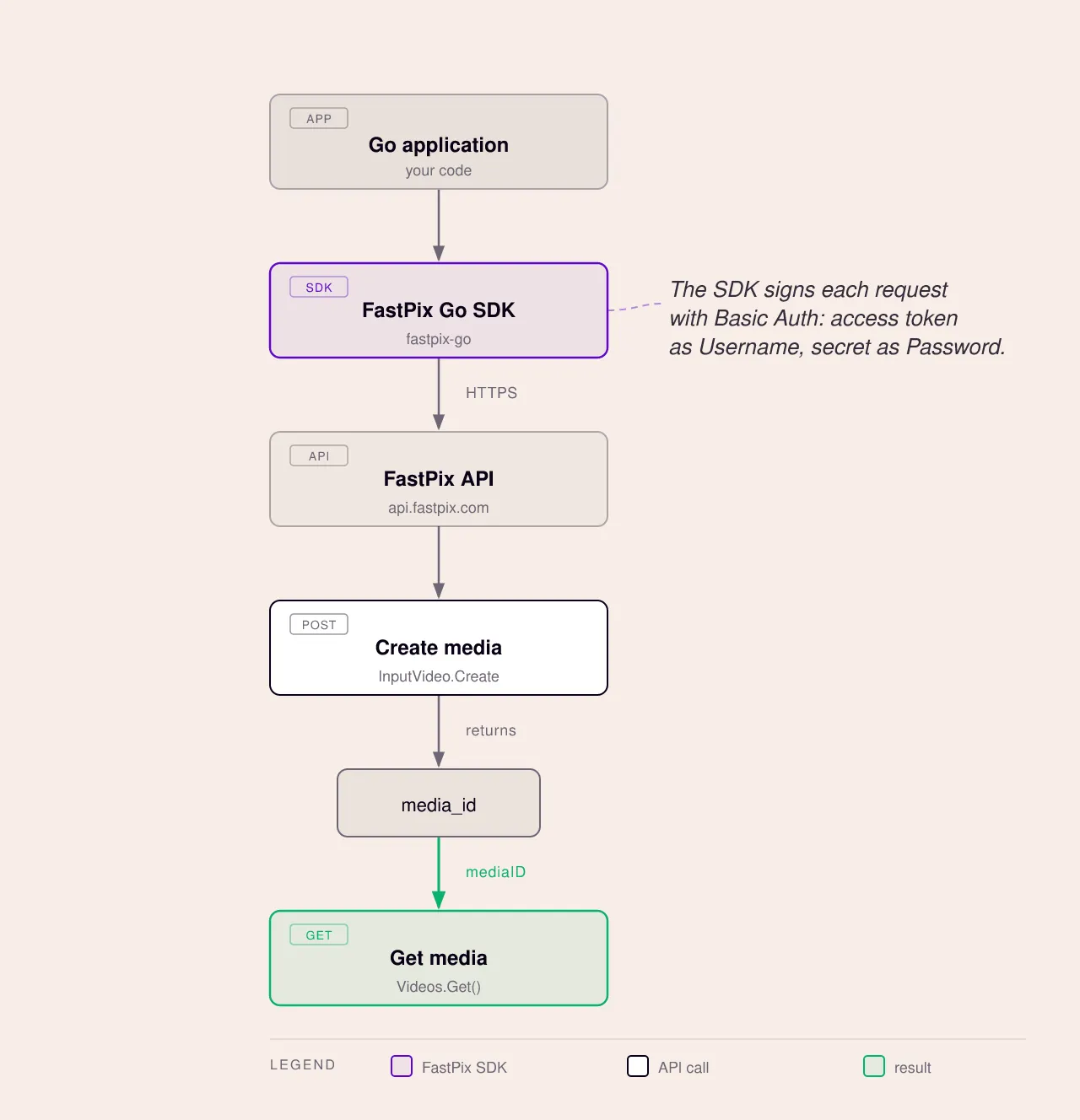
Creating media is usually the first step in a FastPix on-demand workflow: you create the media, poll it until processing finishes, then create a playback ID to play it. The initial SDK integration is now complete.
Resources, error handling, and reference
The SDK is generated from the FastPix API specification, so the complete and always-current reference lives in the repo and the API docs:
- All resources, operations, error handling, retries, server selection, and custom HTTP clients: the FastPix Go SDK on GitHub, with runnable code in the examples directory.
- Media (upload, manage, playback, playlists, signing keys, DRM): Video on Demand API.
- Live (streams, simulcasts, live playback): Live Stream API.
- Video Data (metrics, views, dimensions, errors): Video Data API.
- In-video AI (summaries, chapters, named entities, moderation): In-Video AI.
Frequently asked questions
What is the difference between the FastPix Go SDK and the REST API?
The SDK is a strongly typed Go wrapper around the same FastPix REST API. It handles authentication, request serialization, and response parsing for you, so you call methods like fastpix.InputVideo.Create(...) instead of building raw HTTP requests. Anything the SDK does, you can also do by calling the REST API directly. See Make your first API request.
How do I install the FastPix Go SDK?
Run go get github.com/FastPix/fastpix-go and import it in your module. See Install the FastPix SDK.
How do I authenticate the SDK?
FastPix uses HTTP Basic Authentication. Build the client with components.Security, passing your Access Token as Username and your Secret Key as Password. See Initialize the FastPix client.
How do I upload a video in Go?
Create media from a URL or a direct upload through the input-video resource on the client, for example fastpix.InputVideo.Create(ctx, ...). See Make your first API request.
What is the maximum video file size I can upload with Go?
FastPix uploads are not limited by your Go process memory. When you pull from a URL, FastPix fetches the file directly, and when you upload from a device, the SDK gives you a signed URL that the file goes to directly, so the bytes never pass through your Go application. Large multi-gigabyte files upload without extra configuration. See the Video on Demand API.
How do I start a live stream?
Use the Live API resources to create and manage streams, simulcasts, and live playback IDs. See the SDK reference on GitHub and the Live Stream API.
How do I create a secure playback ID?
Generate playback IDs and manage signing keys and DRM configurations through the Media API resources. See the SDK reference on GitHub and the Video on Demand API.
How do I keep a video private or stop it from being downloaded?
Create the media with a private access policy, then generate a signed playback ID so only holders of a valid token can play it. For stronger protection, enable DRM on the playback ID. You revoke access by deleting the playback ID. Handle all of this through the Media API resources. See the Video on Demand API.
How do I get video analytics and metrics in Go?
The Video Data API exposes metrics, views, dimensions, and errors for quality-of-experience monitoring. See the Video Data API.
How do I handle API errors?
API errors are returned as apierrors.APIError. Use errors.As to inspect the status code and body. See the SDK reference on GitHub for the error types each operation can return.
How do I configure automatic retries?
Pass operations.WithRetries(...) per call, or fastpixgo.WithRetryConfig(...) at initialization, to control the backoff strategy. See the SDK reference on GitHub.
How do I use a custom HTTP client, proxy, or timeout?
Provide any client that satisfies the SDK’s HTTPClient interface (for example an *http.Client with a timeout) through fastpixgo.WithClient(...). See the SDK reference on GitHub.
How do I change the API base URL?
Use fastpixgo.WithServerURL(...) when constructing the client. See the SDK reference on GitHub.
Which Go versions are supported?
Go 1.21 and later. See Before you begin.
What’s next
Want to go further? Browse runnable, end-to-end samples for the FastPix Go SDK in the examples folder of the GitHub repository.
Release notes
For a complete history of releases, improvements, and fixes, see the FastPix Go SDK CHANGELOG on GitHub.